SB 1.17.20
TEXT 20
|
TEXT
अप्रतर्क्यादनिर्देश्याद् इति केष्वपि निश्चयः ।
अत्रानुरूपं राजर्षे विमृश स्वमनीषया ॥ २० ॥ apratarkyad anirdesyad
iti kesv api niscayah
atranurupam rajarse
vimrsa sva-manisaya
apratarkyat-beyond the power of reasoning; anirdesyat-beyond the power of thinking; iti-thus; kesu-someone; api-also; niscayah-definitely concluded; atra-herein; anurupam-which of them is right; rajarse-O sage amongst the kings; vimrsa-judge yourself; sva-by your own; manisaya-power of intelligence.
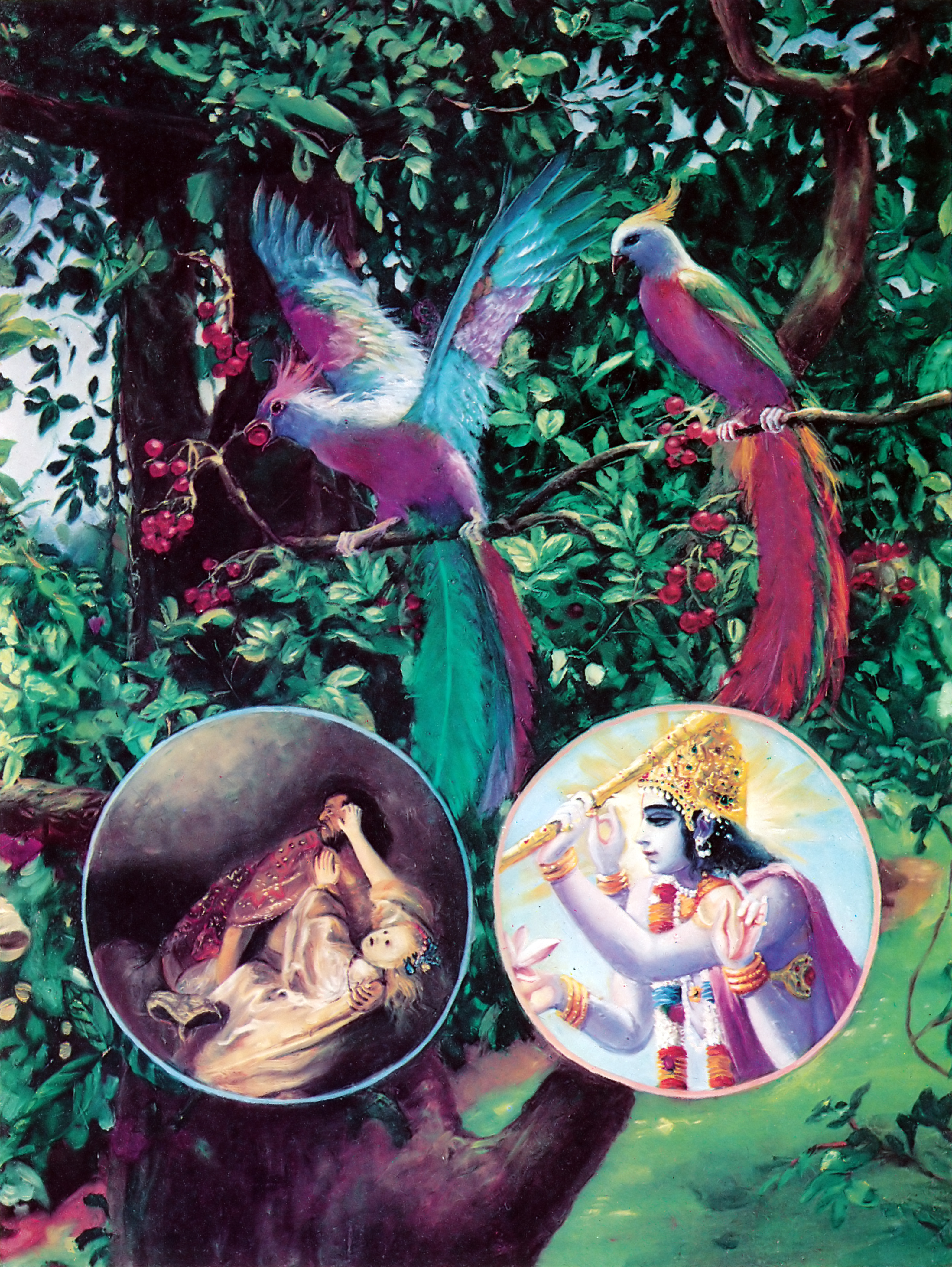 A living being may forget all that he might have done in his past or present life, but one must know that in the same tree of the material body, the individual soul and the Supreme Soul as Paramatma are sitting like two birds. One of them, the living being, is enjoying the fruits of the tree, whereas the Supreme Being is there to witness the activities. TRANSLATION
There are also some thinkers who believe that no one can ascertain the cause of distress by argumentation, nor can one know it by imagination, nor can it be expressed by words. O sage amongst kings, judge for yourself by thinking over all this with your own intelligence.
PURPORT
The Vaisnavites or the devotees of the Lord do believe, as above explained, that nothing can take place with out the sanction of the Supreme Lord. He is the supreme director, for He confirms in the Bhagavad-gita (Bg. 15.15) that He, as all-pervading Paramatma, stays in each and every one's heart and keeps vigilance over all actions and witnesses all activities. The argument of the atheist that one cannot be punished for one's misdeeds, unless proved before a qualified justice, is refuted herein, for we accept the perpetual witness and constant companion of the living being. A living being may forget all that he might have done in his past or present life, but one must know that in the same tree of the material body, the individual soul and the Supreme Soul as Paramatma are sitting like two birds. One of them, the living being, is enjoying the fruits of the tree, whereas the Supreme Being is there to witness the activities. Therefore the Paramatma feature or the Supreme Soul is actually the witness of all activities of the living being, and by His direction only the living being can remember or forget what he might have done in the past. He is, therefore, both the all-pervading impersonal Brahman and the localized Paramatma in everyone's heart. He is the knower of all past, present and future, and nothing can be concealed from Him. The devotees know this truth, and therefore they discharge their duties sincerely, without being overly anxious for rewards. Besides that, one cannot estimate the Lord's reactions either by speculation or by scholarship. Why does He put some into difficulty and not others? He is the supreme knower of the Vedic knowledge, and thus He is the factual Vedantist. At the same time He is the compiler of the Vedanta. No one is independent of Him, and everyone is engaged in His service in different ways. In the conditioned state, such services are rendered by the living being under force by the material nature, whereas in the liberated state the living being is helped by the spiritual nature in the voluntary loving service of the Lord. There is no incongruity or inebriety in His actions. All are on the path of Absolute Truth. Bhismadeva correctly estimated the inconceivable actions of the Lord. The conclusion is, therefore, that the sufferings of the representative of religion and the representative of the earth, as present before Maharaja Pariksit, are planned in order to prove that Maharaja Pariksit was the ideal executive head, for he knew well how to give protection to the cows (the earth) and the brahmanas (religious principles), the two pillars of spiritual advancement. Everyone is under the full control of the Lord. He is quite correct in His action when He desires something to be done by someone, irrespective of the consideration of the particular case. Maharaja Pariksit was thus put to test for his greatness. Now let us see how he solves it by his sagacious mind.
|